FOR PHYSICIANS
HEALTH AND NUTRITION
  Action Alerts
  Breaking Medical News
  Health Topics
  Cancer Resources
  Diabetes Resources
  Food for Life Classes
  Healthy School Lunches
  Vegetarian and Vegan Diets
  Reports and Surveys
  Clinical Research Studies
  Health Care Professionals
ETHICAL RESEARCH & EDUCATION
MEDIA CENTER
LEGISLATIVE FOCUS
CLINICAL RESEARCH
EDUCATIONAL LITERATURE
MEMBERSHIP
SHOP

STAY CONNECTED
Receive action alerts, breaking medical news, e-newsletters, and special offers via e-mail.

Like us on Facebook
Pinterest

Vegan Success Stories

Nutrition CME: Free CME courses for health care professionals

The Cancer Project

Healthy School Lunches: Improving the food served to children in schools

Nutrition MD: Helping health care providers and individuals adopt healthier diets

Nutrition for Kids


Download this fact sheetEssential Fatty Acids


Essential Fatty Acid Basics

The body can synthesize some of the fats it needs from the foods you eat. However, two essential fatty acids cannot be synthesized in the body and can be taken in the diet from plant foods. Their names—linolenic and linoleic acid—are not important. What is important is that these basic fats are used to build specialized fats called omega-3 and omega-6 fatty acids.1

Omega-3 and omega-6 fatty acids are important in the normal functioning of all tissues of the body. Deficiencies are responsible for a host of symptoms and disorders including abnormalities in the liver and kidney, changes in the blood, reduced growth rates, decreased immune function, depression, and skin changes, including dryness and scaliness. Adequate intake of the essential fatty acids results in numerous health benefits. Prevention of atherosclerosis, reduced incidence of heart disease and stroke, and relief from the symptoms associated with ulcerative colitis, menstrual pain, and joint pain have also been documented. 2,3, 4

While supplements and added oils are not typically necessary in the vegetarian diet, good sources of omega-3 and omega-6 fats should be included daily. It is important to take these two fats in the proper ratio as well. Omega-6 fatty acids compete with omega-3 fatty acids for use in the body, and therefore excessive intake of omega-6 fatty acids can be a problem. The U.S. diet has become heavy in omega-6 fats and low in omega-3 fats, secondary to a reliance on processed foods and oils. It is necessary to balance this by eating a low-fat diet that is low in processed foods and with fat mainly coming from omega-3 fatty acids.

Omega-6 Fatty Acids

Omega-6 fats are found in leafy vegetables, seeds, nuts, grains, and vegetable oils (corn, safflower, soybean, cottonseed, sesame, sunflower). Other omega-6 fatty acids, such as gamma-linolenic acid (GLA), can be found in more rare oils, including black currant, borage, evening primrose, and hemp oils.3 Most diets provide adequate amounts of omega-6 fatty acids.

Omega-3 Fatty Acids

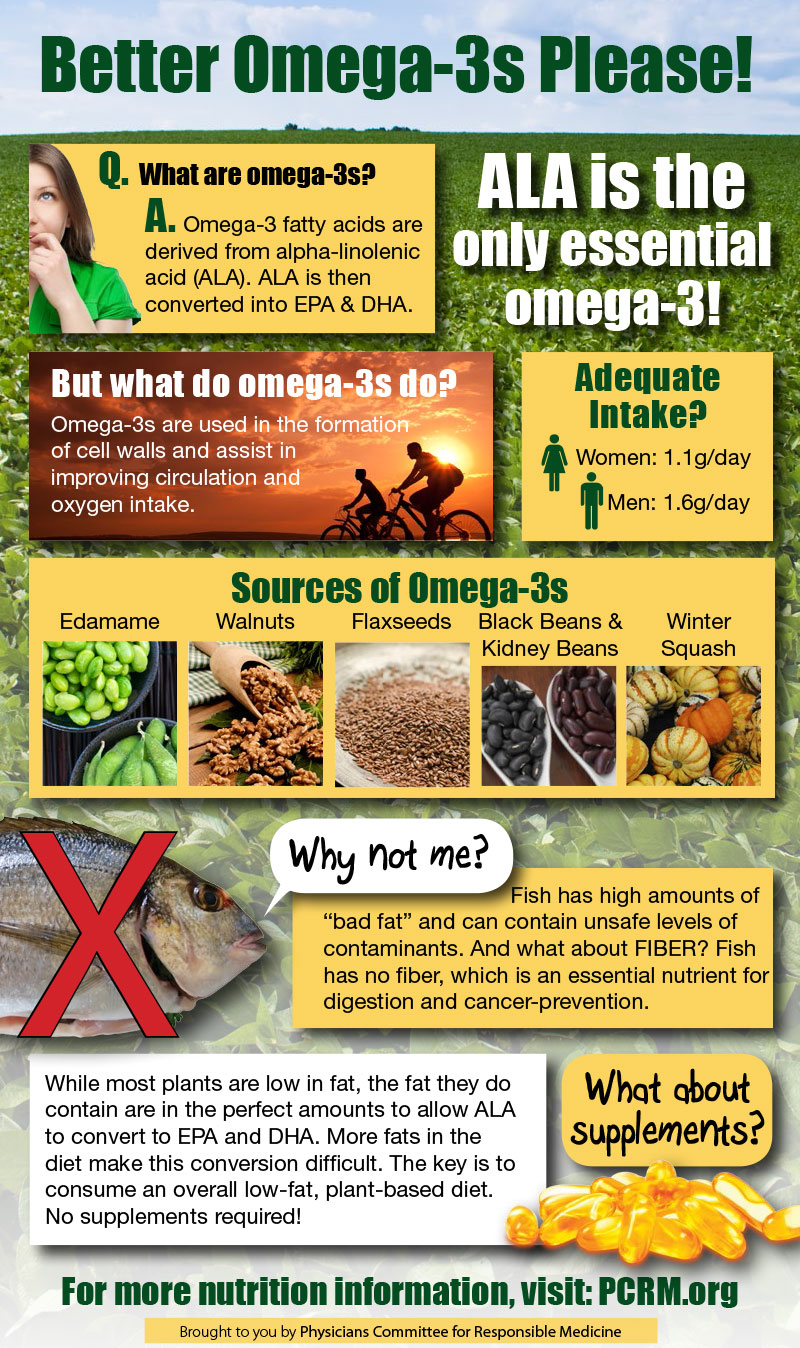
It is important for vegetarians to include foods that are rich in omega-3 fatty acids on a daily basis. Alpha-linolenic acid, a common omega-3 fatty acid, is found in many vegetables, beans, nuts, seeds, and fruits. The best source of alpha-linolenic acid is flaxseeds or flaxseed oil. For those seeking to increase their intake of omega-3 fats, more concentrated sources can be found in oils such as canola (also known as rapeseed), soybean, walnut, and wheat germ. Omega-3 fatty acids can be found in smaller quantities in nuts, seeds, and soy products, as well as beans, vegetables, and whole grains. Corn, safflower, sunflower, and cottonseed oils are generally low in omega-3s.

Plant Foods Rich in Omega-3 Fatty Acids

Ground flaxseed (flax meal)

Walnuts

Soybeans

Mungo beans are particularly high in omega-3 fatty acids. They are sold in many Indian groceries and may be found under the name "urid."

Omega-3 Content of Natural Oils5,6

Flaxseed 53-62 percent

Linseed 53 percent

Canola 11percent

Walnut 10 percent

Wheat germ 7 percent

Soybean 7 percent

Flaxseeds for Omega-3s

Flaxseed oil and ground flaxseeds are particularly good choices to meet your needs for omega-3 fatty acids. One teaspoonful of flaxseed oil or a tablespoonful of ground flaxseed will supply the daily requirement of alpha-linolenic acid. To protect it from oxygen damage, flaxseed oil or ground flax seed must be stored in the refrigerator or the freezer. Use a little in dressings for salads or baked potatoes. Don't try to cook with this oil, however, as heat damages its omega-3s.For you to absorb what you need from flaxseeds, they must be ground. Simply put fresh flaxseeds in a spice or coffee grinder for a few seconds. Some people grind a cup every week or so and store it in the freezer. A spoonful can be added to a smoothie or sprinkled on breakfast cereal, a salad, or other dish.

Pregnancy and Lactation

In pregnancy and lactation, it is especially important to obtain adequate essential fatty acids from the diet. Recent research suggests that pregnant women may have increased needs for these fatty acids, as they are needed for fetal growth, brain development, learning, and behavior. Essential fatty acids are also important for the infant after birth for growth and proper development, as well as the normal functioning of all tissues of the body. Infants receive essential fatty acids through breast milk, so it is important that the mother's diet contain a good supply of omega-3s. Pregnant women and lactating mothers may also opt to take a DHA supplement (DHA, or docosahexaenoic acid, is a form of omega-3 fatty acids). A DHA supplement made from algae, under the trademark V-pure, is available online .

Fish for Essential Fatty Acids?

Some people may have heard that fish are good sources of essential fatty acids. However, the high amounts of fat and cholesterol and the lack of fiber make fish a poor choice. Fish are also often high in mercury and other environmental toxins that have no place in an optimal diet.

Fish oils have been popularized as an aid against everything from heart problems to arthritis. The bad news about fish oils is that omega-3s in fish oils are highly unstable molecules that tend to decompose and, in the process, unleash dangerous free radicals. Research has shown that omega-3s are found in a more stable form in vegetables, fruits, and beans.7, 8

Whether you are interested in promoting cardiovascular health, ensuring the proper growth and development of your child, or relieving pain, a vegetarian diet rich in fruits, vegetables, nuts, seeds, and legumes can help you achieve adequate intake of the essential fatty acids.

References
1. Groff JL, Gropper SS, Hunt SM. Advanced Nutrition and Human Metabolism. West Publishing Company, New York, 1995.
2. Linscheer WG, Vergroesen AJ. Lipids. In: Modern Nutrition in Health and Disease. Shils ME, Olson JA, Shike M, eds. Lea and Febiger, Philadelphia, 1994.
3. Barnard N. Foods That Fight Pain. Harmony Books, New York, 1998.
4. Omega-3 fatty acids and depression: new data. Harv Ment Helath Lett. 2003;19(12):7.
5. Hunter JE. n-3 Fatty acids from vegetable oils. Am J Clin Nutr. 1990;51:809-814.
6. Mantzioris E, James MJ, Gibson RA, Cleland LG. Dietary substitution with an alpha-linolenic acid-rich vegetable oil increases eicosapentaenoic acid concentrations in tissues. Am J Clin Nutr. 1994;59:1304-1309.
7. Odeleye OE, Watson RR. Health implications of the n-3 fatty acids. Am J Clin Nutr. 1991;53:177-178.
8. Kinsella JE. Reply to O Odeleye and R Watson. Am J Clin Nutr. 1991;53:178.

This site does not provide medical or legal advice. This Web site is for informational purposes only.
Full Disclaimer | Privacy Policy

Physicians Committee for Responsible Medicine
5100 Wisconsin Ave., N.W., Ste.400, Washington DC, 20016
Phone: 202-686-2210     Email: pcrm@pcrm.org